We spent the day at Ft De Soto bobbing and relaxing with friends from WCTSS . The day started out windless but the current was in our favor so we all drifted from the launch ramps over to the north side of De Soto beach and cooled off by soaking in the water. The usual afternoon storms started building but they looked like they were going to miss us so some of us decided to wait them out on the beach. Soon enough the storms cleard out and we were rewarded with a decent sailing breeze. Ron yelled let's go and we all jumped in our boats and sailed out Bunces Pass and into the Gulf. We chased each other around for a while, enjoying the light breeze. Ron, at one point skimmed over a shoal and we followed in a slightly different and shallower spot. Kristi pulled the bord up all the way and I had maybe 3 inches of rudder down. We skimmed right over in, maybe 6 inches of water. What fun! Fred, in his Sea Pearl mono "Deja Vu", followed behind us and had to get out for a second to shove over the shoall. Don't follow The Goat into shoals unless you draw 3 inches or so :-). We had a slow but nice run back to the ramps with us in The Goat and 3 Sea Pearls sailing in close company.
Sunday, August 7, 2011

Tuesday, August 2, 2011
Planing Around Canadian Hole
Just got back from a week long trip to Avon on the Outer Banks of North Carolina. Kristi and I trailered The Goat 1800 miles round trip. Avon is a wind surfer's and kiteboarder's Mecca because the sound side is shallow with a strong, predominantly on-shore wind. You screw up and it blows you back to the beach. Very convenient. There are few boat launch sites because of the shallow water so the best option was to launch at Canadian Hole which is mostly a windsurfer's spot.

The first day out the winds were absolutely nuclear. A nearby weather station was reporting 20-30 knots. Since we had no idea how The Goat would handle such conditions we started out with the sail reefed all the way down. We launched and were wondering how wild a ride this would be as the boat was tugging pretty hard just holding her head to wind, in knee deep water. We should'n have been concerned. As soon as we got some crew weight in the boat she settled down and while the ride was very lively we at no time felt out of control or that a capsize was imminent. We had no trouble making way upwind. The water was essentially flat so that helped but it felt like we had enough drive to punch into bigger chop.


Once we figured out that The Goat handles the blow with ease it was time to see what she could do. We never again had wind in the high twenties but we did get consistent 18-22. We hoisted full sail and proceeded to reach back and forth, behaving as if we were sailing our Hobie16. Solo the boat is amazingly manageable when severely overpowered. The yard and battens keep the sail from flogging so luffing upwind is quite civilized. By myself I had way too much sail to go well to windward, as I had to luff a lot but it was doable. The payoff was the broad reaches when the boat would easily get on plane and I was able to sustain 10knot boat speeds for as long as I had sea room. Two up we did much better upwind but the max sustained speed dropped to 9knots. I think my crew was too far forward.

All of this blasting around did come at a price. We capsized and bailed the boat out 4 times in one afternoon.


The first capsize was caused by the mainsheet getting tangled in the tiller on a tack. The other three were off the wind death rolls. I had read somewhere that if, when runing, you let the yard go too far forward bad things may happen with the boat rolling to windward. The first time it happened it was so quick we did not realize what happened. I turned down wind and sheeted out too much and the boat immediately rolled. There was no time to react. We made several more planing reaches and runs without incident and then it happened again. We had to figure out exactly what was causing this so we decided that the last run of the day I would sheet out in small increments and try to sneak up and manage the roll. The run started off fine, we got on plane and I started sheeting out while carefully watching the for the roll. As soon as the yard went a bit past where it should be we rolled. No warning, no way to counter, just a fast hard roll. We were pretty tired by then so we just hung out on the capsized hull and let the wind blow us to shore. Below is a very poor quality video of that last roll when we were ready for it but still got dunked. So the moral of the story is Do Not let the yard go too far forward of the mast when you have full sail up, in a blow!

One is not like the others.
The first day out the winds were absolutely nuclear. A nearby weather station was reporting 20-30 knots. Since we had no idea how The Goat would handle such conditions we started out with the sail reefed all the way down. We launched and were wondering how wild a ride this would be as the boat was tugging pretty hard just holding her head to wind, in knee deep water. We should'n have been concerned. As soon as we got some crew weight in the boat she settled down and while the ride was very lively we at no time felt out of control or that a capsize was imminent. We had no trouble making way upwind. The water was essentially flat so that helped but it felt like we had enough drive to punch into bigger chop.

Discussing takeoff strategy.

Reefed sail shape looks good.


Big grin = big fun
The winds tended to be light in the mornings and picked up in the afternoons. This allowed us to give Goat rides to interested family members in the morning and flog The Goat in the afternoon.

Perfect 10knot breeze.


Bella, my niece, was interested in the boat so we went for a spin. She has been sailing since she was a baby but on a keel boat so the liveliness of The Goat scared her a bit, at first, but I kept the boat pretty flat and she soon was having a good time.

What does this do?

Lets go!

I think she is instructing us on where to sit.


Once we figured out that The Goat handles the blow with ease it was time to see what she could do. We never again had wind in the high twenties but we did get consistent 18-22. We hoisted full sail and proceeded to reach back and forth, behaving as if we were sailing our Hobie16. Solo the boat is amazingly manageable when severely overpowered. The yard and battens keep the sail from flogging so luffing upwind is quite civilized. By myself I had way too much sail to go well to windward, as I had to luff a lot but it was doable. The payoff was the broad reaches when the boat would easily get on plane and I was able to sustain 10knot boat speeds for as long as I had sea room. Two up we did much better upwind but the max sustained speed dropped to 9knots. I think my crew was too far forward.

All of this blasting around did come at a price. We capsized and bailed the boat out 4 times in one afternoon.

Righting the boat is easy. She is very stable on
her side so there is no risk of going turtle.

Bailing is a workout!
The first capsize was caused by the mainsheet getting tangled in the tiller on a tack. The other three were off the wind death rolls. I had read somewhere that if, when runing, you let the yard go too far forward bad things may happen with the boat rolling to windward. The first time it happened it was so quick we did not realize what happened. I turned down wind and sheeted out too much and the boat immediately rolled. There was no time to react. We made several more planing reaches and runs without incident and then it happened again. We had to figure out exactly what was causing this so we decided that the last run of the day I would sheet out in small increments and try to sneak up and manage the roll. The run started off fine, we got on plane and I started sheeting out while carefully watching the for the roll. As soon as the yard went a bit past where it should be we rolled. No warning, no way to counter, just a fast hard roll. We were pretty tired by then so we just hung out on the capsized hull and let the wind blow us to shore. Below is a very poor quality video of that last roll when we were ready for it but still got dunked. So the moral of the story is Do Not let the yard go too far forward of the mast when you have full sail up, in a blow!
Thursday, May 19, 2011
Shelter skelter
Was planning to do the third and final coat of epoxy on the gunwales, last weekend, but the weather had other plans. A severe thunderstorm (news said 70mph gusts) came through and blew my boat shelter to bits. This shelter survived a lot of thunderstorms last summer but the addition of the bug screen sides, in preparation for a bug free clearcoat session, must have added too much windage. Fotunately no damage to The Goat but the shelter tore and the boat filled up with a lot of water. A drain plug of some type may be in my future. Two weeks ago we had to delay leaving for Cedar Key by about an hour in order to not drive The Goat through a downpour. Boat with no drain plug is already getting old. After buying another shelter, cleaning the mess up and and setting up the new shelter I had just enough time left to install the oarlocks.


Total time to date, not counting rebuilding the shelter: 440hrs

Barely missed the boat!

This is water from just hosing the salt off. I tilted the trailer back to make it easier to bail but still a pain. On the plus side, the deck plates did not leak a drop. I used vaseline on the seals which helps a lot.

The oarlock is located and temporarily screwed down to immbilize it so I could scribe an accurate outline onto the gunwale. I'm using stainless oarlocks from West Marine. Looked everywhere and these are the nicest ones I found. Many of the bronze ones look very rough, like they were cast using 1800's technology. While I like the look of weathered bronze it's not quite in line with the Goat's modern aesthetic.

After scribing the oarlock socket's outline onto the gunwale I set up my trusty Bosh router with adjustable fence and held my breath while routing out a pocket for the oarlock socket flange. This is a DO NOT EFF UP MOMENT. One spastic move and irreparable damage occurs. Thankfully all went well.

Router depth stop was set to the thickness of the oar lock socket flange. The corner radii, from the router bit, had to be cleaned up with a small chisel. I found an Xacto knife to be useful for this.

And we have flush mounted oarlock sockets.
Total time to date, not counting rebuilding the shelter: 440hrs
Monday, May 16, 2011
Launch!
Don't have time to write much about the launch so here's just a quick update. We managed to get The Goat into saileable shape for the Cedar Key small boat meet. There's no clearcoat over the epoxy and the hull is just primer but all of the essential bits are there. We launched Saturday May 7th next to the Island Place condos in Cedar Key. Winds were less than 10 knots which was perfect for a first sail. On Sunday we got a bit more wind and had the boat moving nicely. This is going to be fun. Have much to learn about sailing these oldfangled rigs.
Lots of pics in the web albums and a quckie video of the first day out on the water. We're using the GoPro camera handheld which is a bit awkward without a viewfinder so the video is framed very poorly but you get the idea.
Photos of The Goat
Photos of the Cedar Key Small Boat Meet
Lots of pics in the web albums and a quckie video of the first day out on the water. We're using the GoPro camera handheld which is a bit awkward without a viewfinder so the video is framed very poorly but you get the idea.
Photos of The Goat
Photos of the Cedar Key Small Boat Meet
Friday, May 13, 2011
Massive push to the finish
Got behind on the blog as usual but this time it's because I was working on the boat every spare minute to make the Cedar Key maiden launch date. And we made it. Have lots of pics but first, in order to maintain chronological continuity and prevent any nasty temporal paradoxes, I will document how we got there in this mother of all posts.
Fitted and glued the inwales, knees and breasthook. Lots of fiddly parts to fit, trim fit again, trim again and again and again, for many hours. But the result is pretty rewarding.


Fitted and glued the inwales, knees and breasthook. Lots of fiddly parts to fit, trim fit again, trim again and again and again, for many hours. But the result is pretty rewarding.
Inwales trimmed to length and clamped in place ready for breast hook final fitting.

Breast hook halves ready to glue in.

Fitting transom knees.


Odd angles everywhere.


Was going to do the same semicircular cut as on the breast hook, to match the inwale spacers but the angles got the better of me and I gave up and cut the offending bit off. Another inwale spacer fills the space.

Used the deck plate frame as a template to trim masking tape. Keeps the sealant mess to a minimum.

I'm using deck plates which have low profile frames with no fasteners so spring sticks, made from ply offcuts, hold them in place while the goop cures.

Got a power plane to plane down the gunwales but it also makes short work of little scarfs like these for the mahogany gunwale caps.

Couple minutes later.

Gunwale structure glued up slightly above the ply, ready to be planed down to the ply.

After power planing and some hand planing and sanding.

With gunwale caps on, edges rounded with roundover bit in router and final sanded with 120 grit.

Bow sanded ready for epoxy coats.
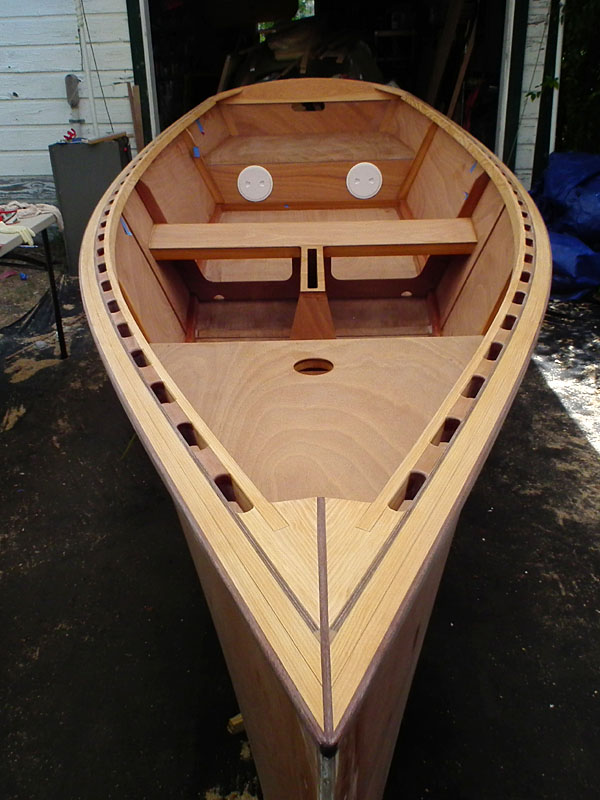
Gunwales ready for epoxy.

First coat of epoxy attracts bastard bugs.

@$^%&*&&!!

Flipped boat over to finish bottom. The runners reveal a couple of flat spots on either side of the bottom ply joint. Ignoring them for now, will fair later.

Flush cutting bit in router makes quick work of cutting the daggerboard slot.

2" glass tape ready to epoxy on chines.

Glass tape epoxied to chines and bow. I used a plane with the blade set at an angle to trim down the tape edges while the epoxy was still green.

The fairing begins. I have hollows where the screws pulled the ply hull sides in and the tape has to be faired in.

It snowed in FL, in April!

First pass with fairing compound sanded and wiped clean. It's not perfect but it will have to do for now. Will coat with epoxy primer for Cedar Key then finish fairing later.

I used System 3 Quick Fair and it is awesome stuff. Will never go back to mixing microbaloons again.

Added a layer of 4oz cloth to the bow for extra beaching abrasion protection.

Epoxy coating the bottom, of course, attracts every bug in the hood.

While the boat was upside down on sawhorses, I used the trailer as a straight clamping jig for the yard and rudder case / tiller.
Total time to date: 435hrs
Subscribe to:
Posts (Atom)